Catch the sun between the shadows.
Explore solar and storage for an off-grid cabin.
Begin with the cabin roof, nearby trees and the energy you want to use. SolarTinker helps you explore how those assumptions interact before moving to a real system design.
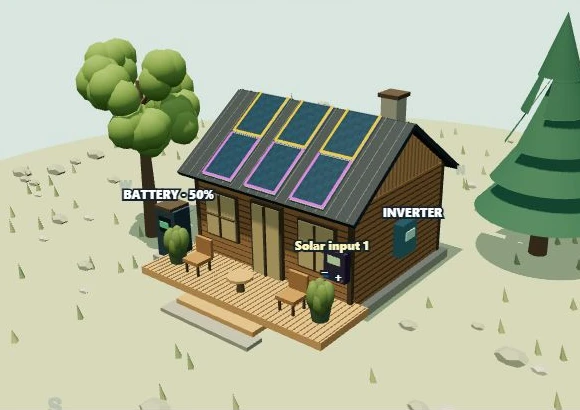
Roof direction and trees come first
The cabin scene accepts panels on the front and rear roof slopes. Enter the cabin dimensions, panel size, latitude and front bearing. Compass bearing describes the building, not the camera: orbiting the view does not rotate the modeled roof.
Position trees using measured height and crown width where possible. Seasonal foliage is an approximation. Explore the dates when you expect to use the cabin; the summer scene alone does not describe winter shade or available sunlight.
Build a load plan, then inspect storage
- Start with the off-grid setup draft. Review the demonstration panels, battery and appliance values; they are not a recommended system size.
- Enter continuous baseline demand and a manual appliance or daily schedule. Avoid counting an appliance in both places.
- Connect panels through the wizard's planner. Review series voltage, parallel current and incomplete equipment checks before applying.
- Run a day and inspect energy flow, battery charge and unmet demand. Battery starting charge is an assumption, not energy produced by that day's panels.
Use actual equipment labels and usage time to estimate demand. A cabin's floor area or number of occupants does not determine its electrical load. Heating, cooking and other intermittent loads may dominate a particular day.
Read off-grid results as energy, not bill savings
Off-grid mode has no utility bill offset. Focus on how much modeled demand is served, when energy is curtailed and when storage runs low. Capacity and inverter power are separate constraints; the model does not prove that a real appliance will start.
An annual estimate repeats representative monthly solar days and uses your chosen weather assumption, carrying storage between days. It is not a historical weather simulation or a reliability assessment for a string of cloudy winter days. See how annual estimates work.
Keep exploring
Classic Solar Optimizer · Solar Schema · Original training videos